Stair Safety and Simple Improvements
Stairs don't change. The same flight that's been climbed a thousand times is still the same width, the same slope, the same number of steps. What changes is everything the body brings to them — balance, strength, depth perception, the ability to shift weight smoothly from one foot to the next without thinking about it.
For a lot of people, stairs start feeling different long before anything dramatic happens. There's more hesitation at the top. A hand reaches for the rail more often. Going down feels less automatic than it used to. These aren't signs that stairs have become impossible — they're early signals that a little attention to the environment could make a real difference.
The good news is that most stair safety improvements are small, inexpensive, and don't change the look or feel of the home. They just make a familiar part of the daily routine feel steadier and less demanding.
Why Stairs Get Harder Over Time
Climbing or descending a staircase is actually one of the more physically complex things people do in their homes every day. It requires balance, leg strength, depth perception, and coordination — all happening simultaneously, usually without much conscious thought.
When any of those factors shift — and they often shift gradually, quietly, without a clear moment of change — stairs start requiring more concentration and more effort. Judging the height and depth of each step becomes less automatic. Fatigue sets in more quickly going up. Descending, which requires controlled weight transfer on every step, can feel less reliable than it used to.
Dimly lit stairs make all of this harder. So does carrying something — groceries, laundry, anything that occupies both hands and removes the option of using the railing. And because these challenges build slowly, they're easy to adapt to without realizing how much the experience of using the stairs has actually changed.
What Actually Makes Stairs Safer
Improving stair safety doesn't require structural changes or major renovation. Most of what helps falls into a few practical categories:
Lighting. This is the single highest-impact change for most staircases. A stairwell that's poorly lit makes it genuinely difficult to judge step edges and depth, especially going down. Good lighting at both the top and bottom of the stairs — and ideally along the stairwell itself — removes one of the biggest risk factors immediately. Motion-activated lights are worth considering for stairs that get used at night.
Visual contrast on step edges. Step edges are where feet land and where depth perception matters most. Adding a strip of contrasting color or texture to the edge of each step — adhesive stair treads are widely available and inexpensive — makes each step significantly easier to read visually. This is especially helpful on stairs where the steps and the risers are similar in color or where carpet makes the edges hard to distinguish.
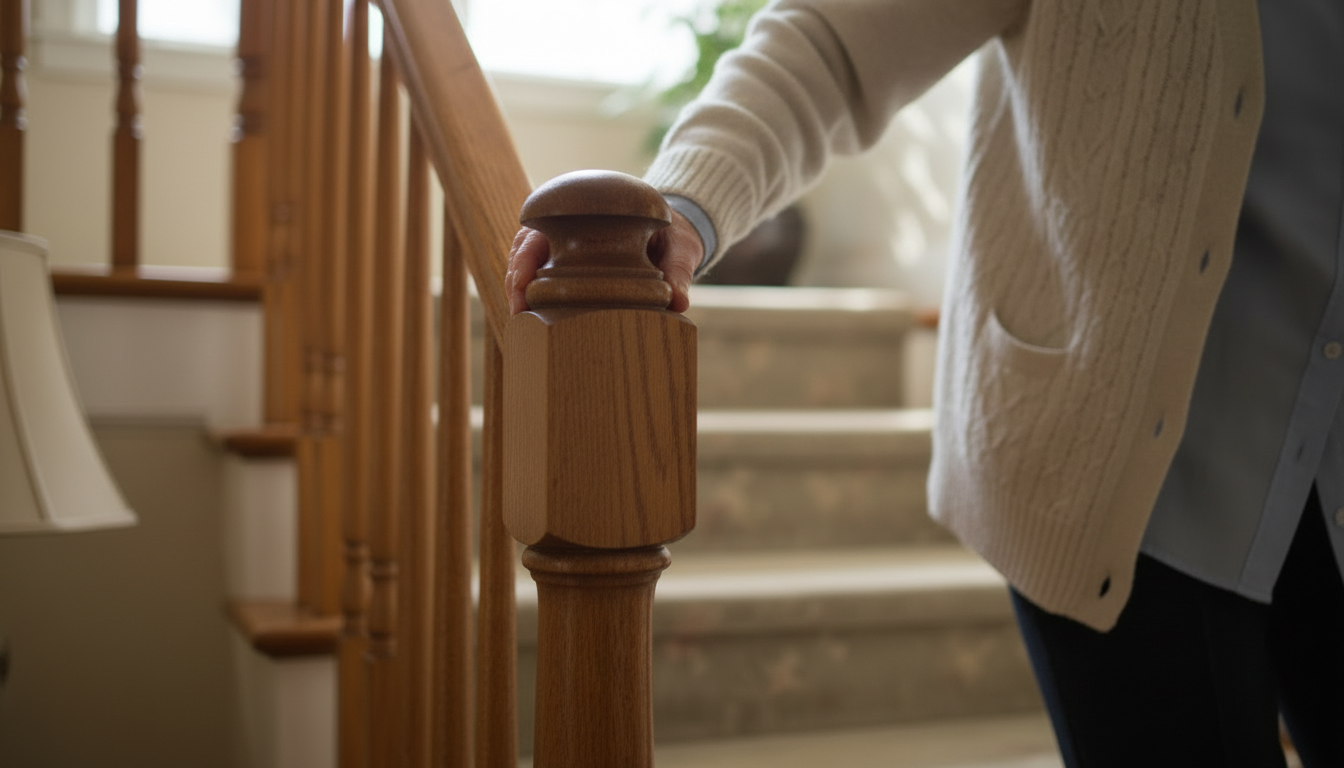
A reliable handrail on both sides. Many staircases have a railing on one side only. Going up, that might be on the preferred side. Coming down, it isn't. A railing on both sides means there's always support available regardless of direction, which matters more as balance becomes less automatic. If adding a second railing isn't possible, making sure the existing one is solid, at the right height, and easy to grip is worth checking.
Keeping stairs completely clear. Stairs have a way of becoming temporary storage — a bag left on a step, a pair of shoes pushed to the side, something waiting to be carried up. These things are hazards, especially going down when the view of lower steps is partially blocked. Keeping stairs consistently clear, without exception, is a simple habit that eliminates a real risk.
Carrying Things on Stairs
One of the most common moments when stair accidents happen is when someone is carrying something. A laundry basket that blocks the view of the steps. A box that requires both hands. A cup of coffee in one hand and a phone in the other.
The simple rule is that stairs deserve both hands free when possible. For laundry, a basket with handles that can be held in one hand — or sliding it down the stairs rather than carrying it — keeps a hand available for the rail. A small tray or caddy for carrying multiple items keeps things together and frees up a hand. For anything heavy or awkward, two trips is always the right answer.
It sounds obvious stated plainly. But in the middle of a busy day, with familiar stairs that have always felt safe, it's easy to make the calculation that it's fine just this once. That's usually when it isn't.
Having the Conversation
For caregivers who want to make stair improvements for someone they love, how the conversation goes matters as much as what gets suggested. Stairs are part of the daily routine, and suggestions about them can feel like commentary on capability rather than concern for comfort.
Asking which part of the stairs feels most tiring, or whether the lighting feels adequate, opens a practical conversation rather than a sensitive one. Trying one change at a time — better lighting first, then stair treads — makes each adjustment feel low-stakes and reversible. And letting the person weigh in on what feels helpful versus what feels unnecessary keeps the process collaborative.
The goal isn't to change how someone uses their stairs. It's to make sure the stairs themselves are set up as well as possible for how they're being used.
Staying Ahead of It
Stair needs can shift gradually as balance, energy, or confidence changes. What feels completely manageable today might feel more demanding in a year — or might feel easier if the lighting gets better and the handrail gets more solid.
Checking in on the stairs occasionally, the same way you'd notice if a light bulb burned out or a step started squeaking, keeps small issues from becoming bigger ones. The stairs aren't going anywhere. Making sure they stay safe and accessible is just good maintenance — for the home and for the person using it.